Lead Ban
"Two Sizes Up" - The Math on Steel vs Lead in Shotgun Cartridges
Two and a half years seems like a long time until the impending transition from lead to steel shot in shotgun cartridges. Most shotgun shooters are continuing to buy and utilise lead shotgun cartridges while they can. However, the stigma around the mandatory transition to steel leaves many people unsure of what it means for the future of shooting—whether it be clay or game. What should shooters start doing to try out steel while there is time, protecting themselves and the sport once the transition is realised on 1st April 2029?
Fifty-five years ago, "Decimal Day" saw the change of British currency from £sd to the decimal system, which left many people puzzled and wondering if the hassle was worthwhile. It had been proven for hundreds, if not thousands, of years in other countries, but the fear of change left many people resenting the idea of the new system. The use of steel shot in shotgun cartridges has also been around for a long time. The year 1999 saw some of the first restrictions put in place over specific wetlands in England, with the whole of the United Kingdom adopting similar policies by 2009. Meanwhile, some European countries had already phased out the use of lead shot since the 1980s and have successfully fired non-toxic loads for decades.
The market for steel shotgun cartridges has certainly been small, but selections have been available from most manufacturers to keep this group of shooters participating responsibly. With the deadline looming, many stockists now face the reality that anything left on the shelf will be lost revenue in less than a few years' time. Manufacturers are already reducing the range of available lead shot cartridges, while simultaneously introducing new steel cartridges to show willingness toward the transition and provide confidence to shooters that steel is an acceptable alternative.
As a stockist of shotgun cartridges in rural Aberdeenshire, ensuring that the information provided to customers is as accurate as possible is essential. This allows them to select the right option for their discipline and be the judge of how effective new ranges of cartridges are for them and their guns. The topic of the lead ban has already come up in conversation with most customers, albeit not normally with a positive outlook. Although there is strong support for responsible shooting with the use of lead shot alongside compliance with existing steel laws, the decision is already made. Sharing more information with game or hobbyist clay target shooters can help guide people to try steel before the mandatory switch.
The math behind steel shotgun cartridges is extensive. Consideration must be given not only to the weight of the load or the size of the shot, but also to the number of pellets, material density, ballistic data, and time-to-target. "Two Sizes Up" has been the typical adage, but after poring through tables upon tables of data, it is possible to look together at why this has become the standard expression and whether it should be followed. Please note that these numbers, although mathematically correct, will always be approximate when put into practice, especially given the permissible tolerances during manufacturing.
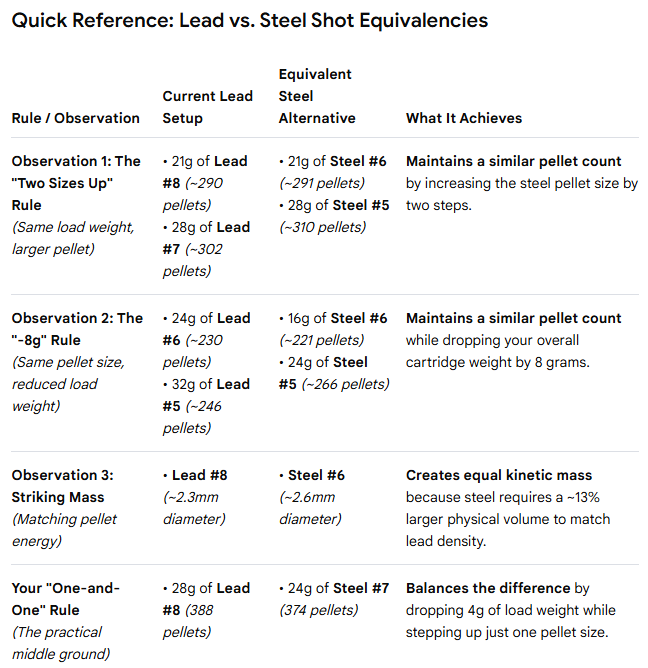
The first observation: A similar shot count (number of pellets) is obtained using the same cartridge load (grams per cartridge) by going two sizes larger for steel versus lead.
Some may argue about trying to achieve exact ballistic equivalence, but a steel shot size approximately 44% larger in diameter than lead would be required to account for the increase in size and the inevitable air resistance when shooting steel—a variable that is difficult to quantify.
Lastly: The time-to-target for a steel shotgun pellet, shot at the same velocity and angle as lead, only adds a split-second delay when shooting at skeet or a typical discipline distance. On a skeet layout of roughly 38 metres, a lead pellet of #7 shot takes 0.15 seconds to get from Stand 1 to the Low House, versus 0.18 seconds for a steel pellet of equivalent size. When breaking a DTL clay at 30 metres, the timing difference is even smaller. For a sporting bird at 75 metres (or approximately 80 yards), the timing difference is just 150 milliseconds.
Additional precautions should be considered when firing steel cartridges versus lead, which have been the more notable points raised by naysayers in the fight against the ban. Older shotguns may not be compatible, as most steel or non-toxic cartridges require nitro-proofing. However, some manufacturers have created a lead-free cartridge that can be safely fired through older guns without the "fleur-de-lis" proof mark, provided the gun is in an acceptable, sound condition.
Furthermore, cartridges with steel shot will likely signal the end of traditional fibre wads. Because plastic or biodegradable cup wads are required to protect the lining of the barrel from hard steel, there is currently no standard fibre wad design available that provides the same level of protection. In the broader fight against single-use plastics, wad materials will likely be the next big focus of legislation.
Shotgun and choke manufacturers also warn against using steel shot through a choke tighter than 1/2 (Modified). This means fixed-choke guns may require modification, though some manufacturers are already designing modern shotguns that allow the shooting of steel up to and including full choke. Lastly, the risk of ricochets must be considered. While lead pellets deform when hitting hard surfaces (such as poles, signs, or the DTL trap house peppered on a local club shoot), steel shot retains its shape and carries a higher risk of bouncing off ricochet-inducing materials.
When looking at the raw data, the "Two Sizes Up" rule creates a clear number of equivalencies and consistencies. The CPSA has increased the permissible shot size by this same margin to reflect the data, but the figures can look baffling when trying to put them into practice on paper.
Would a game shooter shoot a 32g #4 steel cartridge at pigeons instead of a 32g #6 lead? Would a clay shooter aim with a 28g #5.5 steel instead of the trusty #7.5 lead used for years on a similar target? Would someone reduce the load by 8g just to maintain a similar pellet count?
Everyone will have their own view on what to change to once time is up. Clay target shooters today already opt for a larger #6.5 lead load for an edge-on distance bird, while some pest controllers choose a #7 lead load for decoying pigeons. For practical use, a "One-and-One" rule offers an alternative approach to create equivalency to what we are using today.
The "One-and-One" rule: Reduce the load by one increment of 4g, while increasing the pellet size by one full size.
Legislation changes are pushing many people to consider whether they wish to maintain their licence. Hand-in-hand with the ever-increasing cost of renewing licences, the rising prices of cartridges and clays are making it difficult to keep the financial cost and effort reasonable. Whilst a change like banning lead shot is a sharp corner to turn, we must remember the reasons we took up the sport in the first place. Whether it is spending time dusting clays—a pastime passed down the family tree—sitting in a hide with a few friends decoying pigeons, or enjoying grouse days with partners and associates, shooting is here to stay. By keeping the sport in high demand, we continue to advocate for this traditional sport and way of life. If we have to shoot steel to keep doing what we love, we will.
Two and a half years seems like a long time until the impending transition from lead to steel shot in shotgun cartridges. Most shotgun shooters are continuing to buy and utilise lead shotgun cartridges while they can. However, the stigma around the mandatory transition to steel leaves many people unsure of what it means for the future of shooting—whether it be clay or game. What should shooters start doing to try out steel while there is time, protecting themselves and the sport once the transition is realised on 1st April 2029?
Fifty-five years ago, "Decimal Day" saw the change of British currency from £sd to the decimal system, which left many people puzzled and wondering if the hassle was worthwhile. It had been proven for hundreds, if not thousands, of years in other countries, but the fear of change left many people resenting the idea of the new system. The use of steel shot in shotgun cartridges has also been around for a long time. The year 1999 saw some of the first restrictions put in place over specific wetlands in England, with the whole of the United Kingdom adopting similar policies by 2009. Meanwhile, some European countries had already phased out the use of lead shot since the 1980s and have successfully fired non-toxic loads for decades.
The market for steel shotgun cartridges has certainly been small, but selections have been available from most manufacturers to keep this group of shooters participating responsibly. With the deadline looming, many stockists now face the reality that anything left on the shelf will be lost revenue in less than a few years' time. Manufacturers are already reducing the range of available lead shot cartridges, while simultaneously introducing new steel cartridges to show willingness toward the transition and provide confidence to shooters that steel is an acceptable alternative.
As a stockist of shotgun cartridges in rural Aberdeenshire, ensuring that the information provided to customers is as accurate as possible is essential. This allows them to select the right option for their discipline and be the judge of how effective new ranges of cartridges are for them and their guns. The topic of the lead ban has already come up in conversation with most customers, albeit not normally with a positive outlook. Although there is strong support for responsible shooting with the use of lead shot alongside compliance with existing steel laws, the decision is already made. Sharing more information with game or hobbyist clay target shooters can help guide people to try steel before the mandatory switch.
The math behind steel shotgun cartridges is extensive. Consideration must be given not only to the weight of the load or the size of the shot, but also to the number of pellets, material density, ballistic data, and time-to-target. "Two Sizes Up" has been the typical adage, but after poring through tables upon tables of data, it is possible to look together at why this has become the standard expression and whether it should be followed. Please note that these numbers, although mathematically correct, will always be approximate when put into practice, especially given the permissible tolerances during manufacturing.
The first observation: A similar shot count (number of pellets) is obtained using the same cartridge load (grams per cartridge) by going two sizes larger for steel versus lead.
- For example: There are around 290 pellets of lead #8 against 291 pellets of steel #6 in a 21g shotgun cartridge. Similarly, on a 28g load, there should be 302 pellets of lead #7 or 310 pellets of steel #5.
- For example: The shot count on a 24g load with lead #6 shot is around 230, while a 16g steel #6 load contains an almost equivalent 221 pellets. In a second example, the shot count on a 32g load filled with lead #5 is roughly 246, compared to a similar count on a 24g load with #5 steel containing 266 pellets.
Some may argue about trying to achieve exact ballistic equivalence, but a steel shot size approximately 44% larger in diameter than lead would be required to account for the increase in size and the inevitable air resistance when shooting steel—a variable that is difficult to quantify.
Lastly: The time-to-target for a steel shotgun pellet, shot at the same velocity and angle as lead, only adds a split-second delay when shooting at skeet or a typical discipline distance. On a skeet layout of roughly 38 metres, a lead pellet of #7 shot takes 0.15 seconds to get from Stand 1 to the Low House, versus 0.18 seconds for a steel pellet of equivalent size. When breaking a DTL clay at 30 metres, the timing difference is even smaller. For a sporting bird at 75 metres (or approximately 80 yards), the timing difference is just 150 milliseconds.
Additional precautions should be considered when firing steel cartridges versus lead, which have been the more notable points raised by naysayers in the fight against the ban. Older shotguns may not be compatible, as most steel or non-toxic cartridges require nitro-proofing. However, some manufacturers have created a lead-free cartridge that can be safely fired through older guns without the "fleur-de-lis" proof mark, provided the gun is in an acceptable, sound condition.
Furthermore, cartridges with steel shot will likely signal the end of traditional fibre wads. Because plastic or biodegradable cup wads are required to protect the lining of the barrel from hard steel, there is currently no standard fibre wad design available that provides the same level of protection. In the broader fight against single-use plastics, wad materials will likely be the next big focus of legislation.
Shotgun and choke manufacturers also warn against using steel shot through a choke tighter than 1/2 (Modified). This means fixed-choke guns may require modification, though some manufacturers are already designing modern shotguns that allow the shooting of steel up to and including full choke. Lastly, the risk of ricochets must be considered. While lead pellets deform when hitting hard surfaces (such as poles, signs, or the DTL trap house peppered on a local club shoot), steel shot retains its shape and carries a higher risk of bouncing off ricochet-inducing materials.
When looking at the raw data, the "Two Sizes Up" rule creates a clear number of equivalencies and consistencies. The CPSA has increased the permissible shot size by this same margin to reflect the data, but the figures can look baffling when trying to put them into practice on paper.
Would a game shooter shoot a 32g #4 steel cartridge at pigeons instead of a 32g #6 lead? Would a clay shooter aim with a 28g #5.5 steel instead of the trusty #7.5 lead used for years on a similar target? Would someone reduce the load by 8g just to maintain a similar pellet count?
Everyone will have their own view on what to change to once time is up. Clay target shooters today already opt for a larger #6.5 lead load for an edge-on distance bird, while some pest controllers choose a #7 lead load for decoying pigeons. For practical use, a "One-and-One" rule offers an alternative approach to create equivalency to what we are using today.
The "One-and-One" rule: Reduce the load by one increment of 4g, while increasing the pellet size by one full size.
- In practice: Instead of shooting clays at a local ground with a 28g #8 lead load, the choice would be a 24g #7 steel. This still gives a highly comparable number of pellets in the cartridge (374 #7 steel pellets against 388 #8 lead) and slightly increases the pellet mass over a lighter steel #8 shot.
Does this mean that we couldn't maintain shooting clays with a 28g cartridge? Absolutely not! If we can increase our shot count we will increase our pattern density.
If we could shoot a #5 at clays, should we? Of course! Greater pellet sizes give us better kinetic energy and less reliance on pattern density.
However, this is the math and data behind the change. Everyone will pick up something new in steel and like it, or hate it.
Graeme Cheeseman - Grampian Cartridges